Wudang Mountain Introduction
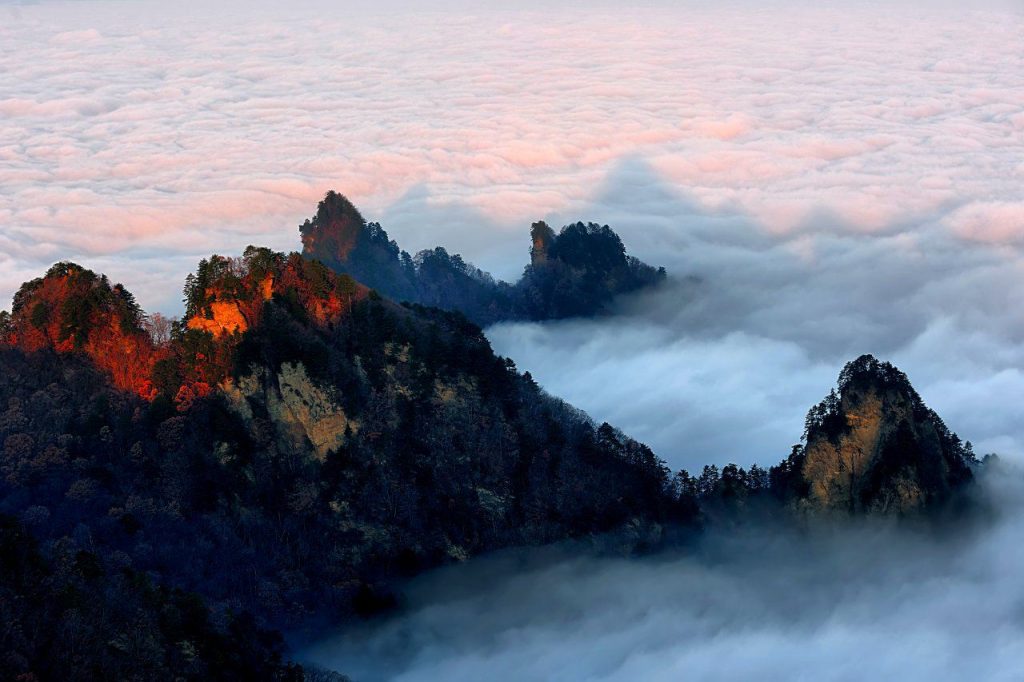
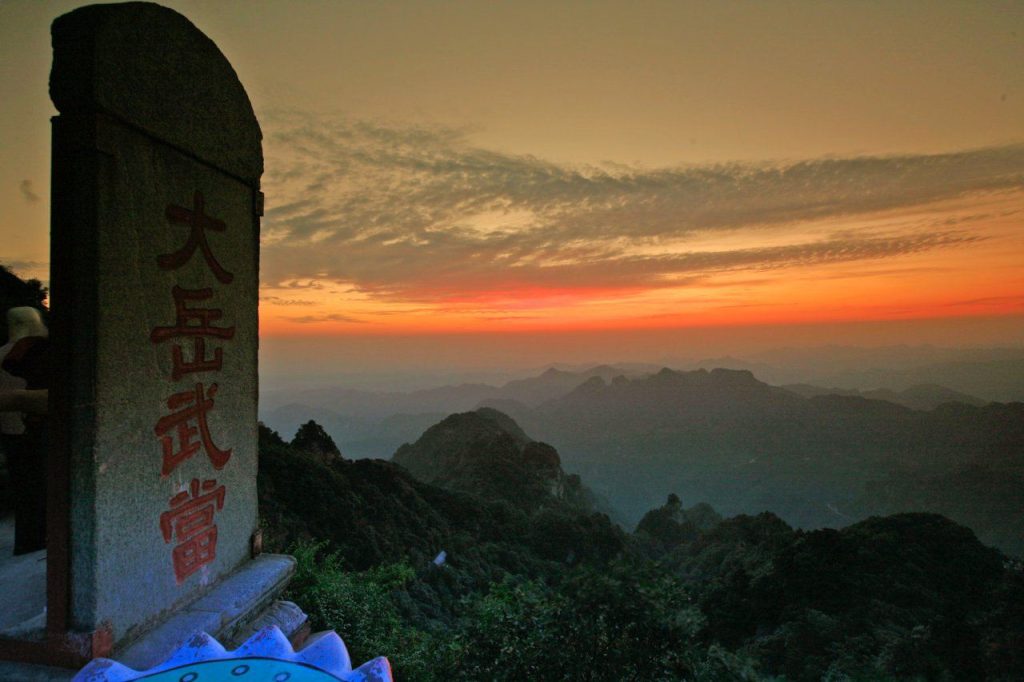
Wudang Mountain, a sacred Taoist site in China, is also known as Taihe Mountain, Xieluo Mountain, Canshang Mountain, and Xianshi Mountain. In ancient times, it was honored with titles such as “Taiyue,” “Xuanyue,” and “Dayue.” It is located in Danjiangkou City, Shiyan City, in the northwestern part of Hubei Province. It borders Xiangyang City to the east, leans against Shiyan City to the west, overlooks Shennongjia to the south, and faces the Danjiangkou Reservoir—the source of the middle route of the South-to-North Water Diversion Project—to the north. During the Ming Dynasty, Wudang Mountain was conferred the titles “Dayue” and “Zhishi Xuanyue” by the emperor and was revered as the “Imperial Family Temple.” It is world-famous for its status as the “Crown of the Five Sacred Mountains,” with “all four great mountains bowing in reverence and celestial peaks from five directions paying homage.”
As a renowned Taoist mountain and the birthplace of Wudang Kungfu, it is hailed as “an unparalleled scenic wonder since ancient times and the foremost celestial mountain under heaven.” Wudang Kungfu is an important school of Chinese martial arts. In the late Yuan and early Ming Dynasties, Taoist priest Zhang Sanfeng synthesized its essence and founded the Wudang Sect. As of 2013, Wudang Mountain boasted 53 ancient architectural structures with a total floor area of 27,000 square meters, 9 architectural ruins covering over 200,000 square meters, and 5,035 cultural relics preserved throughout the mountain.
In December 1994, the Ancient Building Complex of Wudang Mountain was inscribed on the World Heritage List. In 2006, it was designated as a Major Historical and Cultural Site Protected at the National Level in its entirety. In 2007, Wudang Mountain, together with scenic spots such as the Great Wall, Lijiang, and Zhouzhuang, was selected as one of the “Top Ten Chinese Scenic Spots Most Loved by Europeans.” From 2010 to 2013, it was successively rated as a National AAAAA Tourist Attraction, a National Forest Park, one of the “Top Ten Summer Resort Mountains in China,” a Cross-Strait Exchange Base, and was included in the list of the most beautiful National Geoparks.
Major Attractions
Wudang Mountain features numerous scenic wonders, including 72 peaks, 36 cliffs, 24 gorges, 11 caves, 3 pools, 9 springs, 10 ponds, 9 wells, 10 rock formations, and 9 terraces. Centered around Tianzhu Peak, the scenic area boasts perilous paths like the Upper and Lower Eighteen Bends, as well as iconic landscapes such as “Seventy-Two Peaks Bowing to the Main Summit” and “Golden Hall Overlapping Shadows.” The most famous palaces and temples include: Golden Summit, Taihe Palace, Nanyan Palace, Zixiao Palace, Fuzhen Temple, Qiongtai Temple, and Wulong(Five Dragon) Palace.
Wudang Taoism
From the Spring and Autumn Period to the late Han Dynasty, many high-ranking officials and nobles came to Wudang Mountain to cultivate themselves, including Yin Xi, a senior official of the Zhou Dynasty, and renowned alchemists Ma Mingsheng and Yin Changsheng, who also secluded themselves here for spiritual practice. From the late Han Dynasty to the Northern and Southern Dynasties, amid social turmoil, hundreds of scholar-officials either resigned from official posts or abandoned their families, gathering at Wudang Mountain to practice bigu (abstinence from grains) and pursue Taoism. During this period, scriptures related to Zhenwu (the True Warrior) also emerged.
In the Sui and Tang Dynasties, the Li Tang royal family claimed to be descendants of Laozi, vigorously supporting and revering Taoism and elevating it to the foremost position among the three religions. During the Zhenguan reign of the Tang Dynasty, Yao Jian, Military Commissioner of Wudang, was ordered to pray for rain on Wudang Mountain, and his prayer was answered. The emperor then issued an edict to build Wulong Shrine—the first temple constructed by imperial decree on Wudang Mountain. At this time, many eminent Taoists secluded themselves here for cultivation, including Yao Jian, Sun Simiao, Tao You’an, and Lü Dongbin. By the late Tang Dynasty, Wudang Mountain had been ranked as the Ninth of the Seventy-Two Blessed Lands in Taoism, significantly enhancing its Taoist status.
During the Song and Yuan Dynasties, rulers strongly promoted and venerated the Zhenwu God of Wudang, continuously elevating his divine status, which facilitated the formation of Wudang Taoism and its growing social influence. In 1018 (the 2nd year of the Tianxi reign), Emperor Zhenzong of the Song Dynasty conferred the title “True Warrior, Spiritually Responsive Lord” on Zhenwu, ordered the construction of shrines and statues for worship, and upgraded Wulong Shrine to a temple. Emperor Renzong of the Song Dynasty revered Zhenwu as the “Patron God of the State and Family” and built a Zhenwu Temple with statues for worship. Emperors Huizong, Ningzong, and Lizong all bestowed titles on Zhenwu and offered devout sacrifices.
In the Yuan Dynasty, Taoism was highly favored by the rulers, and Wudang Mountain became an important Taoist site for the Yuan emperors to “pray to heaven and celebrate longevity,” enabling Wudang Taoism to flourish. Many folk believers made pilgrimages to offer incense, and the religious site thrived. Wudang Taoism’s social influence grew steadily, and Wudang Mountain became a sacred Taoist site on par with Longhu Mountain, the ancestral mountain of the Celestial Masters Sect.
During the Ming Dynasty, Wudang Mountain was consistently supported by the emperors as the “Imperial Family Temple,” and the Zhenwu God of Wudang was venerated as the “National Protector God.” Its status was elevated to “the foremost celestial mountain under heaven,” surpassing the Five Sacred Mountains and becoming the national center of Taoist activities, maintaining a prosperous situation for over 200 years. Emperor Zhu Yuanzhang, the founder of the Ming Dynasty, revered Zhenwu, laying the foundation for his descendants’ worship of the god. It was Emperor Zhu Di, the Yongle Emperor, who propelled Wudang Taoism to its peak. After seizing power from his nephew Zhu Yunwen, Zhu Di claimed that Zhenwu had blessed him and his father to gain the empire. To repay the divine grace, in 1412 (the 10th year of the Yongle reign), he dispatched officials to build 33 temples, including Nine Palaces and Nine Temples, on the ruins of the Yuan Dynasty. Following Emperor Yongle, successive Ming emperors, imperial relatives, nobles, local officials, and believers from all directions continued to construct and expand temples here. During the reign of Emperor Jiajing (Zhu Houcong), stone paths were built leading to the platform in front of the main hall.
Ancient Architecture of Wudang Mountain
The ancient buildings of Wudang Mountain can trace their origins to the Qin and Han dynasties, when many recluses and Taoists built thatched huts and temples here. During the Zhenguan reign of the Tang Dynasty (627–649), Emperor Taizong ordered the construction of the Wulong Shrine. In the Dali reign (766–779), temples such as Taiyi and Yanchang were erected. In the 3rd year of the Qianning reign (896), the “New Temple of the Mighty God of Martial Valor” was further built.
During the reign of Emperor Zhenzong of the Song Dynasty, Wulong Shrine was promoted to Wulong Temple. In the Xuanhe reign (1119–1125), Zixiao Palace was founded.
In the Yuan Dynasty, 9 palaces and 8 temples were completed.
During the Yongle reign of the Ming Dynasty, Emperor Yongle dispatched Zhang Xin, Marquis of Longping, Mu Xin, Commandant of the Imperial Son-in-Law, Jin Chun, Minister of Rites, Guo Jin, Vice Minister of Works, and other officials, leading over 300,000 soldiers, civilians, and craftsmen. Over 12 years, they built 33 architectural complexes, including 9 palaces and 9 temples, along a 160-li construction route on Wudang Mountain. Expansions and additions were made during the Chenghua and Jiajing reigns, making Wudang Mountain the largest Taoist center in China at that time. According to incomplete statistics, there were more than 500 buildings of various types and over 20,000 halls and rooms during the Ming Dynasty.
After the completion of the Taoist palaces and temples, Wudang Mountain was transformed from a “Taoist sanctuary for the Perfect One” into an “imperial family temple”. After ascending the throne, successive Ming emperors sent imperial envoys to Wudang Mountain to offer sacrifices to Zhenwu and perform Taoist rituals. Moreover, imperial decrees ordered ritual ceremonies for the enshrinement of bestowed divine statues, the annual birthday celebrations of the emperor, and the anniversary of the ascension of the Dark Emperor.
The entire architectural complex was uniformly laid out in strict accordance with the legend of Zhenwu’s cultivation and adopted imperial architectural standards. It created the artistic conception of a “fairy mountain with heavenly pavilions”, stretching for 140 li:
*One nunnery every five li, one palace every ten li;
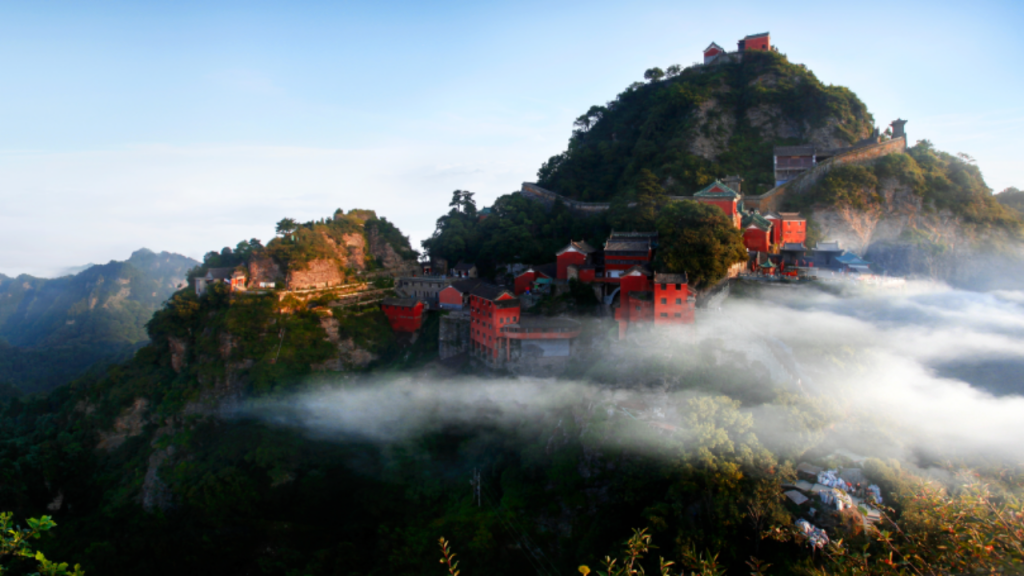
Red walls and green tiles shine exquisitely.
Terraces and towers glow with golden and silver light,
Mountains and forests twist like a painted mirror.
It is the largest religious architectural complex in the world today, achieving a profound, transcendent, and naturally integrated artistic effect. It fully embodies the Taoist philosophy of “harmony between man and nature”, and is regarded as a wonder in the history of ancient Chinese architecture. It is honored as “a museum of ancient Chinese architectural achievements” and “the Forbidden City hanging on precipices”.
From the Qing Dynasty to the Republic of China, the buildings of Wudang Mountain were gradually reduced in scale, destroyed by wars, damaged, or collapsed. After the founding of the People’s Republic of China, the Party and the government adopted a series of measures to protect the ancient buildings. The Hubei Provincial Government listed all ancient buildings on the mountain as key provincial cultural relics under protection. The Golden Hall, Zixiao Palace, the Zhishi Xuanyue Stone Archway, Nanyan Palace, and the ruins of Yuxu Palace were designated as key national cultural relics under protection. The state allocated special funds to restore and rebuild more than 200 halls and rooms covering over 30,000 square meters, repair three ancient pilgrimage paths up the mountain, and restore more than a dozen ancient bridges. There are still 129 well-preserved buildings and 1,182 temple rooms, with a construction area of 43,332 square meters, retaining their grandeur of the past.
The ancient architectural complex of Wudang Mountain was designed and arranged according to the myth of Zhenwu’s cultivation recorded in the Scripture of Zhenwu, highlighting the theme of Zhenwu worship. According to the scripture, Zhenwu was born in the Kingdom of Jingle; hence, Jingle Palace was built outside Junzhou City. Wulong, Zixiao, and Nanyan were the places where Zhenwu cultivated. Yuxu Palace was named after Zhenwu’s title “Teacher of the Jade Emptiness”. Yuanhe Temple was built for Zhenwu’s administration of the Yuanhe Transfer Office. Huilong Temple, Huixin Nunnery, Mozhen Well, Taizi Slope, Longquan Temple, the Upper and Lower Eighteen Bends, Tianjin Bridge, and Jiudu Gorge are all related to the myth of Zhenwu’s cultivation, creating a strong religious atmosphere. Pilgrims are immersed in the legendary atmosphere of Zhenwu’s practice as soon as they enter Wudang Mountain, subtly deepening their faith and reverence for Zhenwu.
The overall layout of the complex centers on the Golden Hall on Tianzhu Peak, radiating outward along official roads and ancient pilgrimage paths. It extends 80 kilometers north to the stone archway by Xiangshui River, 25 kilometers south to Yousheng Temple in Yanchi River, 50 kilometers west to Heilong Temple in Bailang, and 35 kilometers east to Jieshan Temple. Designed uniformly in imperial architectural style, the whole complex is grand, clearly themed, and well-organized. It also reflects the Taoist thought of “revering nature”, preserving the original natural landscape of Wudang Mountain. Craftsmen designed the layout following Emperor Chengzu Zhu Di’s principles: “assess its breadth”, “determine its rules”, and “not alter the mountain itself in the slightest”. Construction materials were not locally sourced but purchased from Shaanxi, Sichuan, and other regions. During construction, the lofty peaks and steep, secluded gorges were fully utilized. Each architectural unit was placed in a suitable position on peaks, hills, cliffs, or gorges, with properly spaced distances and scaled sizes. Buildings integrated organically with the surroundings, achieving an artistic effect of appearing and disappearing, dimly visible, and merging into one.
Overall, the ancient architectural complex of Wudang Mountain aggregates the finest architectural styles of ancient China. It embodies the grandeur of imperial palaces, the mystery of Taoism, the tranquility and elegance of gardens, and the simplicity and frugality of folk architecture, forming a rich and diverse traditional architectural style. Zhang Kaidong of the Ming Dynasty described Wudang’s buildings as:
Supplementing the legacy of Qin Shi Huang and Han Wu Di, rarely seen in successive dynasties;
Showcasing the splendor of golden palaces and jade halls, unparalleled in the world.
In 1982, when the State Council designated Wudang Mountain as a key national scenic area, it praised the ancient architectural complex as “a magnificent project with exquisite craftsmanship, successfully embodying the artistic conception of a ‘fairy mountain with heavenly pavilions’, like an exhibition of China’s ancient architectural achievements”.
On December 17, 1994, it was inscribed on the World Heritage List by UNESCO.